
Teaching History articles
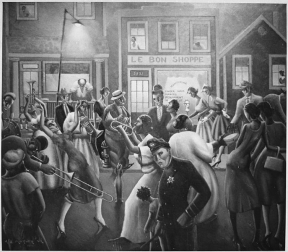
Inspired by reading the work of Stephen Tuck, Ellie Osborne set out to design a new sequence of lessons that would help her students adopt a longer lens on the American civil rights movement. At the same time, Osborne wanted to put more emphasis on the agency and campaigns of...
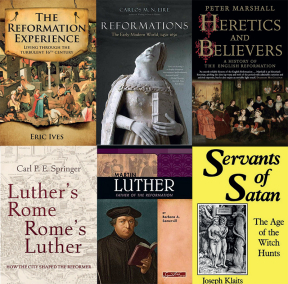
Sarah Jackson-Buckley and Jessie Phillips found themselves perennially dissatisfied with the outcomes of their teaching of the Protestant Reformation. Determined that students should take away a sense of the momentous political and social consequences of the Reformation, they turned to historical scholarship, and to the work of other history teachers...
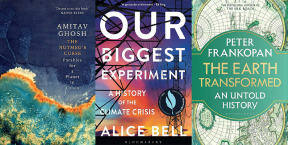
In this article Michael Riley and Alison Kitson seek to unlock the potential of the secondary history curriculum to educate young people about the current ecological and climate crisis in ways that might also inform their thinking about how to create a more sustainable future. The article (which mirrors a...

Move Me On is designed to build critical, informed debate about the character of teacher training, teacher education and professional development. It is also designed to offer practical help to all involved in training new history teachers. Each issue presents a situation in initial teacher education/training with an emphasis upon...
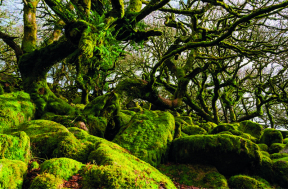
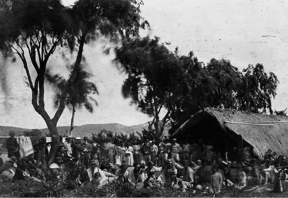
Barbara Trapani’s article sprung from, and is written in, hope. Through introducing the history of, specifically, Europeans’ relationships with trees in Madeira, the Banda Islands and Britain, Trapani enabled her Year 8 pupils to appreciate the ways in which exploitative nations have used irreplaceable resources and profoundly altered ecosystems and...
Is this climate change lesson geography or history, Miss? When thinking about teaching climate change in schools we often associate it with subjects like geography or even science, but we hardly think about history. And yet, history has as much claim on this topic as other subjects do, especially when...
Curious about the absence of the physical environment in her school’s schemes of work, and fascinated by the changing relationships between humans and landscapes in the past, history teacher and PhD researcher Verity Morgan decided to design new lessons that brought environmental history into her classroom. Rather than ‘bolting on’...
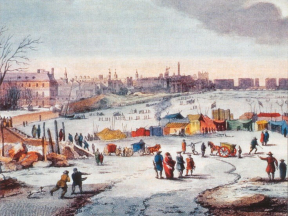
Although some historians object to ‘presentism’ – studies of the past that are explicitly driven by present-day concerns – climate history as a field would probably not exist otherwise. Expensive technology is required to gather the raw data for research into past climates. Interdisciplinary collaboration is needed to develop robust...
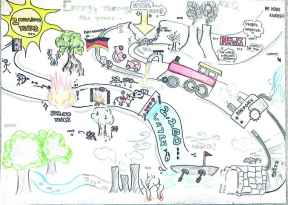
This article, written mainly by Alison Kitson with reflections on classroom experience from Nebiat Michael, focuses on teaching about the industrial revolution. It offers new ways of framing the topic, both as a result of the ‘energy binge’ on which modern civilisation is built and as the third of four...
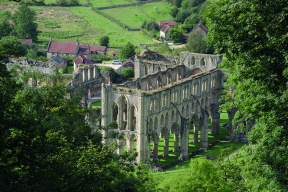
Helen Snelson has long been an enthusiastic advocate for learning history outside the classroom. In recent years, as the extent of the climate crisis has become ever more apparent, she has been rethinking her approach to teaching within and about the historic environment. In this article, written in consultation with...
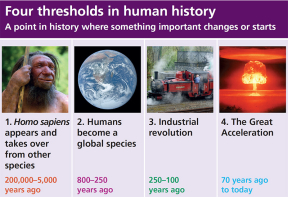
How can we bring climate change into our classrooms without making it ‘small’? Peter Langdon tackled this question by drawing on a ‘big history’ approach to design an enquiry that allowed his students to think about the relationship between humans and climate throughout the whole history of our species. Langdon’s...
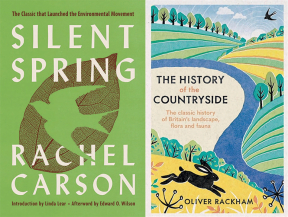
Kate Hawkey has long been an advocate for teaching about the history of climate change. This article, co-authored with Paula Worth, David Rawlings and Dan Warner-Meanwell, first outlines key arguments from her pioneering book History and the Climate Crisis, before illustrating the range of ways in which a group of...
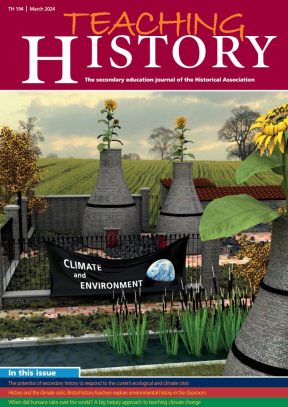
Read Teaching History 194: Climate and Environment The current ecological and climate crisis is, without doubt, human-induced. Even those who previously disputed this claim have switched from outright denial to arguing that the threat is exaggerated.1 Meanwhile, many young people are responding to the crisis with strong emotions, such as...
Move Me On is designed to build critical, informed debate about the character of teacher training, teacher education and professional development. It is also designed to offer practical help to all involved in training new history teachers. Each issue presents a situation in initial teacher education/training with an emphasis upon...
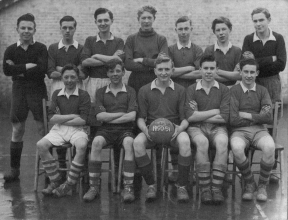
Helen Southwood here sets out an example of a hyperlocal history study the focus of which is her own school. She presents a rationale both for the study of hyperlocal history as a means of engaging students and developing their skills, and for the pedagogical use of previously uncatalogued school...
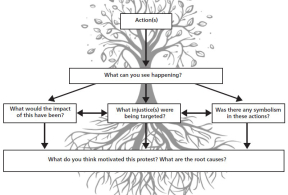
While studying for his master’s degree in education, Arthur Casey became intrigued by research suggesting that analogies comparing past and present might improve students’ perceptions of the relevance of history. In this article he reports on the findings of his own small-scale research study, in which he used a present-day...
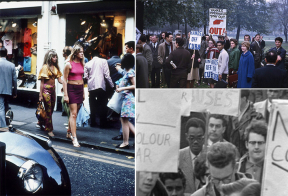
For such a boldly iconoclastic work, the Key Stage 3 textbook A New Focus on ... British Social History, c.1920–2000 (2023) provides a disarmingly conventional account of youth in the 1960s as ‘mostly better educated and informed than their parents had been at their age [and able] … to find...
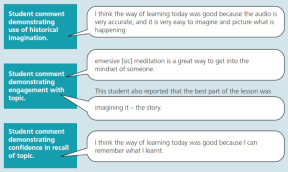
James Hopkins’s Year 10 class had been excited by their course on medicine through time, but were less enthused about their new study of Norman England. They told him that the topic felt ‘distant’ and ‘not real’. Recalling his own experience as a student, Hopkins was interested in the ways...
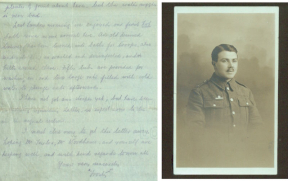
Deep into my PGCE year, I found myself discussing with my mentor how to pre-empt the barriers to understanding the past that students may face. One barrier we discussed was presentism: the tendency of students to interpret the past in light of their own modern knowledge, values and experiences. In...
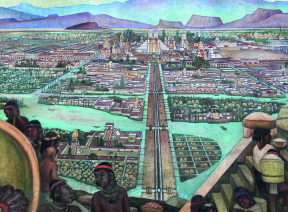
After discussing a new book about the Mexica (Aztecs) during a routine meeting with a trainee teacher, Niamh Jennings decided to construct a sequence of lessons around the history of the Mexica Empire. Struck by the vivid storytelling of historian Camilla Townsend in her book Fifth Sun, and fascinated by...