Britain & Ireland

What was it about industrialisation that led to the emergence of a woman’s movement in Victorian Britain? Why do we see so many people fighting for so many rights and liberties in this period and what are the origins of some of the issues we still campaign on today? This section includes our major series on Social and Political Change in the UK from 1800 to the present day. There are also articles and podcasts on the often violent relationship between England and Ireland during this period and England’s changing relationship with Scotland and Wales. Read more

Sort by: Date (Newest first) | Title A-Z
  • Spencer Perceval: private values and public virtues

    Article

    The public man and his career Spencer Perceval's career as a public figure lasted from 1796 when he became a King's Counsel and MP for Northampton until his murder sixteen years later at the age of 49. He was shot in the lobby of the House of Commons at 5.15pm...

    Click to view
  • Sporting Heritage EPQ

    Article

    Are you interested in both history and sport and undertaking an EPQ project?   Sporting Heritage is a not-for-profit community interest company working specifically to support the collection, preservation, access, and research of sporting heritage in the UK and wider.   Part of their remit also involves fostering interest in and dissemination...

    Click to view
  • Stalinism

    Article

    Stalin's remarkable career raises quite fundamental questions for anyone interested in history. Marxists, whose philosophy should cause them to downgrade the role of ‘great men' as an explanation of great events, have problems in fitting Stalin into the materialist interpretation of history: did not this man ride rough-shod over the...

    Click to view
  • Stanley Baldwin's reputation

    Article

    Falsification of history is normally associated with dictatorships rather than liberal democracies. Yet tendentious accounts of the recent past are part of the armoury of all types of political debate. Such manipulation usually has only a limited and short-term influence, because it is neutralised by different political parties offering contending...

    Click to view
  • Strange Journey: the life of Dorothy Eckersley

    Article

    Meeting in Berlin Three days before the outbreak of the Second World War, William Joyce, the leader of the British Nazi group, the National Socialist League, was in Berlin. He and his wife, Margaret, had fled there fearing internment by the British government if war broke out. Yet as war...

    Click to view
  • TV: modern father of history?

    Article

    Bettany Hughes Norton Medlicott Medal Winner Lecture In 1991 I travelled to the BBC for a meeting with a senior television producer. It seemed to me that history just wasn't getting a fair crack of the whip. I talked animatedly about the on-screen discoveries that could be made and the...

    Click to view
  • Tank development in the First World War

    Article

    The emergence of the tank as a further weapon of war is inextricably associated with Lincoln where various early models were developed. By 1915 the Great War had gone just about as far as it could and for the first time, the way an entire war was fought was described...

    Click to view
  • The 'Penny Dreadful'

    Article

    "I wish I know'd as much as you, Dick. How did you manage to pick it up?" "Mother taught me most, and I read all the books I can get." "So do I; sich rattling tales, too ---‘The Black Phantom; or, the White Spectre of the Pink Rock.' It's fine,...

    Click to view
  • The Advent of Decimalisation in Britain: 1971

    Article

    Decimal Day in Britain was Monday 15 February 1971. New coins and notes were circulated. There was no special issue postage stamp to commemorate the occasion, only a new series with some unfamiliar values, such as 7½p instead of 1s 6d. The fortieth anniversary of the arrival of decimal currency...

    Click to view
  • The Battle of Waterloo: Sunday 18 June 1815

    Article

    John Morewood explores the events of 18 June 1815 in detail and asks just how accurate is our view of what happened on the field of Waterloo. Summary Waterloo is the most famous battle in a four-battle campaign fought from 15 June to 19 June 1815. On one side were...

    Click to view
  • The Black Leveller

    Article

    History is rarely far removed from today's concerns. What is true of history in general is true of biography; specifically. Darcus Howe: a political biography is no exception. In writing it, we were consciously intervening in current debates about Britain and ‘race'. The impetus to write emerged in 2008 during...

    Click to view
  • The Bristol Riots

    Article

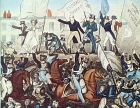
    In 1831, Bristol suffered the worst outbreak of urban rioting since the Gordon Riots in London over fifty years earlier. Twelve rioters were officially declared to have died as a result of confrontations with troops and special constables, and many more unidentifiable corpses were discovered among the ruins of the...

    Click to view
  • The British Empire on trial

    Article

    In the light of present-day concerns about the place, in a modern world, of statues commemorating figures whose roles in history are of debatable merit, Dr Gregory Gifford puts the British Empire on trial, presenting a balanced case both for and against. In June 2020 when the statue of slave-trader Edward Colston...

    Click to view
  • The British General Strike 1926

    Article

    ‘The General Strike is a challenge to Parliament and is the road to anarchy and ruin.' (Stanley Baldwin, Prime Minister, 6th May 1926). ‘The General Council does not challenge the Constitution ... the sole aim of the Council is to secure for the miners a decent standard of life. The Council...

    Click to view
  • The British Government's Confidential Files on the United States

    Article

    Unpublished papers in Britain's National Archives at Kew reveal curious undercurrents in Anglo-American relations. After the conclusion of the Boer War, for example, the British Army supposed that the next major conflict would be not with Germany but with the U.S. A memo printed for circulation in July 1904 entitled ‘A...

    Click to view
  • The British Union of Fascists: the international dimension

    Article

    Fascism failed in Britain in the 1930s – Europe’s decade of the ‘Brown plague’. Unlike in many European countries, fascists in Britain were never a serious threat to the democratic order. This was not for want of trying, especially on the part of Sir Oswald Mosley and his British Union...

    Click to view
  • The British soldier in the Revolutionary and Napoleonic wars

    Article

    Scum of the earth – or fine fellows? Carole Divall asks whether the men of the British Army really were ‘the scum of the earth’, as often asserted, or willing soldiers who earned the respect of the French. ‘Soldiers were regarded as day labourers engaged in unsavoury business; a money...

    Click to view
  • The Cambridge Anthropological Expedition to the Torres Strait 1898-1899: The birth of social anthropology?

    Article

    Dr John Shepherd reviews the history of a major anthropological expedition one hundred years ago. On 10 March 1898 The Times reported that Cambridge Anthropological Expedition led by Alfred Cort Haddon had sailed from London, bound for the Torres Strait region between Australia and New Guinea. In Imperial Britain, the...

    Click to view
  • The Centenary of the First World War: An unpopular view

    Article

    We are delighted to have an original article by Gary Sheffield in this edition of The Historian. Gary Sheffield is Professor of War Studies, University of Wolverhampton. He is a specialist on Britain at war 1914-45 and is one of Britain's foremost historians on the First World War. He has...

    Click to view
  • The Chapel and the Nation

    Article

    The Noncoformitst chapel has played a crucial role in the history of the English and Welsh nations. When the great French historian Elie Halevy sought to explain the contrast between the turbulent history of his own country and the peaceful evolution of England in the late eighteenth and nineteenth centuries...

    Click to view