Britain & Ireland

What was it about industrialisation that led to the emergence of a woman’s movement in Victorian Britain? Why do we see so many people fighting for so many rights and liberties in this period and what are the origins of some of the issues we still campaign on today? This section includes our major series on Social and Political Change in the UK from 1800 to the present day. There are also articles and podcasts on the often violent relationship between England and Ireland during this period and England’s changing relationship with Scotland and Wales. Read more

Sort by: Date (Newest first) | Title A-Z
  • Promoting the First World War, 1914-16

    Article

    The popular image of the First World War is of young men leaving the tedium of the factory or the mine to volunteer for service on the Western Front in one of Kitchener’s new armies. Less well known is the background effort that went into maintaining and strengthening morale as...

    Click to view
  • Queen Victoria

    Article

    A century ago Britain celebrated Queen Victoria’s diamond jubilee – her reign having provided 60 years of stability at the height of Britain’s imperial power. Dorothy Thompson profiles the woman at the heart of the Empire. More than any other British monarch, with the possible exception of her one-time model,...

    Click to view
  • Queen Victoria as a Politician

    Article

    Even had Queen Victoria not presided over the achievements of the age which bears her name, her career would still hold a fascination for the historian. She was, for one thing, the solitary woman in a male political world. She was possessed of a personality at once perceptive and simple,...

    Click to view
  • Quixotically Generous...Economically Worthless'

    Article

    William Kenefick considers two views of the dockers and the dockland community in Britain in the 19th and early 20th centuries. 'Quixotically generous and economically worthless’! But what does this mean? How does this curious descriptor help us understand the docker or the waterside community? Indeed, does it tell us...

    Click to view
  • Radicalism and its Results, 1760-1837

    Article

    Radicalism with a large "R", unlike Conservatism with a large "C" and Liberalism with a large "L", is not a historical term of even proximate precision. There was never a Radical Party with a national organization, local associations, or a treasury. But there were, and there are, "Radicals", generally qualified...

    Click to view
  • Real Lives: Mrs Annabel Dott (1868–1937)

    Article

    Our series ‘Real Lives’ seeks to put the story of the ordinary person into our great historical narrative. We are all part of the rich fabric of the communities in which we live and we are affected sto greater and lesser degrees by the big events that happen on a daily...

    Click to view
  • Real Lives: Who was Sir John Steell?

    Article

    Our series ‘Real Lives’ seeks to put the story of the ordinary person into our great historical narrative. We are all part of the rich fabric of the communities in which we live and we are affected to greater and lesser degrees by the big events that happen on a daily...

    Click to view
  • Recorded Webinar: Female slave-ownership in 18th and 19 century Britain

    Article

    Click to view
  • Recorded Webinar: Nineteenth-century crime and punishment

    Article

    This webinar with Dr Emma D Watkins explores the changing understanding of crime and responses to it in the nineteenth-century. It provides a brief overview on the general shift from punishment of the body, to banishment, all the way through to imprisonment. With a particular emphasis on the use of...

    Click to view
  • Recorded webinar: Queer beyond London

    Article

    London has tended to dominate accounts of LGBTQ Britain… but how did local contexts beyond the capital affect queer identities and communities? This talk by Professor Matt Cook looks at Brighton, Plymouth, Manchester and Leeds to illustrate the difference locality makes to queer lives. * Please note: while this webinar...

    Click to view
  • Recorded webinar: Untold Stories of D-Day

    Article

    The HA has worked with film-maker,  historian and Legasee ambassador Martyn Cox on a series of webinars looking at untold stories from the Second World War. Many of these stories are taken for the oral histories provided in interviews given to Martyn on film.  In this filmed webinar, Martyn goes...

    Click to view
  • Remember Peterloo!

    Article

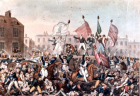
    The BBC News at 10 on Saturday 5 July included an announcement that Manchester's campaign to have a memorial erected to the victims of the Peterloo Massacre had ‘got under way'. That afternoon, a workshop organised by the Peterloo Memorial  campaign had encouraged members of the public to express their...

    Click to view
  • Remembering Neville Chamberlain

    Article

    Brent Dyck is a Canadian teacher and a previous contributor to The Historian. In this short essay he offers us his objective interpretation of the achievements of Neville Chamberlain. For some what he says may seem surprising and for others it might even be controversial. However, editorially it seemed entirely proper...

    Click to view
  • Robert Peel: Portraiture and political commemoration

    Article

    On 4 March 1856, during a debate in the House of Lords on a motion to form a ‘Gallery of National Portraits', the Conservative peer Earl Stanhope quoted Thomas Carlyle's view that ‘one of the most primary wants [of the historian is] to secure a bodily likeness of the personage...

    Click to view
  • Round About A Pound A Week

    Article

    In this edition, we begin a new occasional feature, where we explore a classic text that had a major impact both at the time it was published, and since. Alf Wilkinson discusses a book first published in 1913, and still in print, and explains why he thinks it is as...

    Click to view
  • Royal Women: Queen Anne, Elizabeth I and Elizabeth II

    Multipage Article

    In June 2012 the Historical Association and Historic Royal Palaces joined forces to offer a fantastic CPD opportunity in line with the Queen's diamond jubilee. Two CPD events around the theme of Royal Women charted the private histories of queens of the past from within the walls of their palaces. What...

    Click to view
  • Schools of Vice: how a medical scandal led to the dismantling of Britain’s last prison hulks

    Article

    Hulks – former naval ships used as prisons for those convicted of serious crime and sentenced to transportation – were intended to be a temporary solution to a penal crisis caused by the American Revolutionary Wars. These ‘schools of vice’, or ‘floating hells’ lasted 80 years, casting a shadow over...

    Click to view
  • Sir Francis Fletcher Vane, anti-militarist: The great boy scout schism of 1909

    Article

    Sir Francis Patrick Fletcher Vane, fifth baronet (1861-1934), a man of wideranging but seemingly contradictory passions and interests, was an idealistic but also hard-working aristocrat who played a major role in shaping the early Boy Scout movement in London. While the name of the founder of the Boy Scouts, Robert...

    Click to view
  • Smithfield's Bartholomew Fair

    Article

    On the north-western side of the City of London, directly in front of St Bartholomew's Hospital near the ancient church of St Bartholomew the Great, there once lay a ‘smooth field', now known as Smithfield. This open space of around ten acres had a long and turbulent history. In medieval...

    Click to view
  • Social Darwinism: the myth and its reinvention

    Article

    ‘Social Darwinism’ has been associated in academia and popular consciousness with negative concepts such as hyper-nationalism and eugenics. Geoffrey M. Hodgson challenges the notion that Social Darwinism or its proponents were ever well-defined. By tracing the use of ‘Social Darwinism’ across academic disciplines and globally over a long period, Hodgson...

    Click to view