

Teaching History 201: Out now
The HA's journal for secondary history teachers
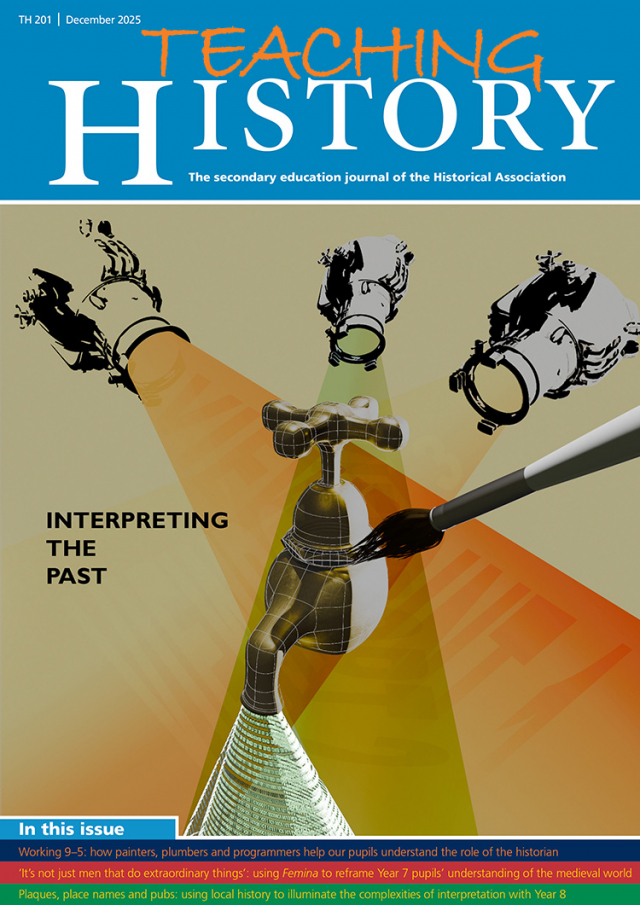
Editorial: Interpreting the Past
Read Teaching History 201: Interpreting the Past
Interpreting the past is the daily bread-and-butter of history teaching. In each lesson, an history teacher interprets the past to their pupils, structuring and shaping the way in which they present historical material in order to form a coherent lesson. Planning lesson sequences and designing the overarching sequence of a coherent curriculum are also acts of historical interpretation.
Yet, for pupils to understand history as a discipline, and not simply to accumulate knowledge of the past, they must understand this process of interpretation for themselves. For this reason, the National Curriculum enshrines an entitlement for pupils not merely to encounter interpretations of the past, but to analyse them.1 This means equipping young people to engage critically with a range of interpretations – both scholarly and popular – that were never originally intended for classroom use. As history teachers have long recognised, teaching pupils to understand and to think critically about ‘how and why contrasting arguments and interpretations of the past have been constructed’ is neither easy nor straightforward.2 Each of the authors writing in this journal wrestles with the challenges inherent in this process; collectively they offer a varied range of powerful ways to surmount them.
Jessie Phillips and Sarah Jackson-Buckley sought to address the underlying reasons why pupils find working with historical interpretations challenging. They researched pupils’ understanding of history as a discipline and describe three contrasting ‘viewpoints’ that characterise pupils’ perceptions of how historians interpret the past. Phillips and Jackson-Buckley then devised analogies to help their pupils to discuss the process in which historians engage when they interpret the past.
Freya George took inspiration from one particular historian, Janina Ramirez. Like Phillips and Jackson-Buckley, George wanted to shift her pupils’ perceptions by engaging them in thinking more deeply about how historians interpret the past. In this case, she wanted to shift pupils’ own interpretations of the medieval period, by teaching them not only about the women whose stories Ramirez researched, but also about gender history. George and her students analysed the intentions behind Ramirez’s scholarship in Femina, and the methods she used to recentre and reshape the narrative of the medieval past.
Sarah Hartsmith and Andrea Hale were also inspired by Janina Ramirez’s Femina, and by their local context. They noticed that their large cohort of pupils of Polish origin saw little Polish history prior to the conflicts of the twentieth century presented in the curriculum. In their Triumphs Show, they share how they devised a lesson drawing on Ramirez’s interpretation of Jadwiga of Poland in order to add an eastern European dimension to a Year 7 enquiry about power and authority in the medieval world.
A year ago, several authors in Teaching History 197 called for pupils to be educated about the construction of public history and popular memory. A number of the authors in this journal have taken up that challenge. Like Hartsmith and Hale, Jack Harris took inspiration from his local context. His article makes a powerful case for local history as a way in for pupils to a deeper understanding of interpretations of the past in popular culture and collective memory. Harris worked with local heritage professionals to devise a project for Year 8 pupils in which they would study the varying ways in which Sir Harry Smith had been remembered and interpreted, not only by historians but in the local area, in pub names and street names, and in the naming of their own school.
Like Harris, William Mason wanted his pupils to understand that interpretations of the past are found not only in works of historical scholarship, but all around them. Whereas Harris focused on local interpretations, Mason was interested in collective memory on a larger scale. Mason examined ways in which ‘myths’ of the past are constructed and deployed for political ends. He designed an enquiry for his students to examine how the ‘myth’ of Winston Churchill has been used for different purposes on different occasions. Mason reflects on the challenges that this gave his pupils and devised a series of metaphors which, like Phillips and Jackson-Buckley’s analogies, could be used to make the concept of collective memory more concrete.
Tom Leather introduced his pupils to contemporary political interpretations of ancient history. His article shares a lesson sequence in which pupils learned about ways in which Cyrus the Great has been interpreted – sometimes misinterpreted – and used to serve political agendas in Iran and in the western world. Leather shares how he and his colleagues worked to strengthen their own subject knowledge, and how reflection and analysis of pupils’ responses, as well as feedback from their HA Quality Mark assessment, helped to refine their teaching.
Linda Colley’s interpretation of Toussaint L’Ouverture and the Haitian Revolution within the context of the history of constitutions gave Ben Arscott inspiration to write this edition’s Cunning Plan. Meanwhile, Robert Dale provides an update for teachers on interpretations of Stalinism and the role of Stalin in the postwar USSR.
References
1 Department for Education (2014) ‘History programmes of study: key stage 3’, accessible at: https://assets.publishing.service.gov.uk/media/5a7c66d740f0b626628abcdd/SECONDARY_national_curriculum_-_History.pdf
2 Department for Education, op. cit.; Historical Association (2019) ‘What’s the Wisdom On… interpretations of the past’, Teaching History, 177, Building Knowledge Edition, pp. 23–27.