Britain & Ireland

What was it about industrialisation that led to the emergence of a woman’s movement in Victorian Britain? Why do we see so many people fighting for so many rights and liberties in this period and what are the origins of some of the issues we still campaign on today? This section includes our major series on Social and Political Change in the UK from 1800 to the present day. There are also articles and podcasts on the often violent relationship between England and Ireland during this period and England’s changing relationship with Scotland and Wales. Read more

Sort by: Date (Newest first) | Title A-Z
  • Gary Sheffield: Origins of the First World War

    Article

    Gary Sheffield, Professor of War studies, the University of Wolverhampton, is one of the UK's foremost historians on the First World War.  He is the author of numerous books and previously held posts at the University of Birmingham and the Royal Military Academy Sandhurst. In April 2014 he spoke at an HA event for teachers...

    Click to view
  • Gladstone and the London May Day Demonstrators, 1890

    Article

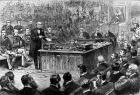
    One hundred and twenty years ago the advent of the first red May Days caused major concern across Europe. To general surprise, in 1890 and the next few years some of the largest rallies occurred in London. In Britain the main demonstration on the nearest Sunday to May Day passed...

    Click to view
  • Guy Fawkes in Manchester: The World of William Harrison Ainsworth

    Article

    Some of the most enduring myths in British history were created and perpetuated by novelists, despite the fact that the historical novel has long been relegated to the second division of the literary arts. Deeply unfashionable today, writers like Sir Walter Scott, Edward Bulwer Lytton and William Harrison Ainsworth were...

    Click to view
  • Hammer, House of Horror: The making of a British film company, 1934 to 1979

    Article

    The now legendary film company Hammer made such classics as The Curse of Frankenstein (1957) and Dracula (1958), plus their numerous sequels and subsequent remakes of old Universal Gothic chillers (The Curse of the Werewolf, The Mummy, The Phantom of the Opera), as well as making international stars out of Peter...

    Click to view
  • Harriet Kettle, Victorian rebel

    Article

    Harriet Kettle had a remarkable life. She was on the receiving end of everything that the institutions of social control in Victorian England could throw at her, but resisted, survived and fought back. Harriet’s defiance earned her references in the records of a workhouse, two prisons, two asylums and, in...

    Click to view
  • Hat on headstones

    Article

    The grave markers in churchyards and cemeteries are for the most part depressingly unimaginative both in their design and in their inscriptions but one occasionally meets with an attempt at striking an individual note, such as a sculpted depiction of a motor vehicle, or an animal, or the head-gear worn...

    Click to view
  • Heritage and History

    Article

    Moves to protect and record the historic environment began at the turn of the 20th century with the establishment of the National Trust in 1895, the Victoria County History in 1899, and the Royal Commission on Historical Monuments for England in 1908. The VCH took the antiquarians’ task onto a...

    Click to view
  • History Abridged: Balmoral

    Article

    History Abridged: This feature seeks to take a person, event or period and abridge, or focus on, an important event or detail that can get lost in the big picture. Think Horrible Histories for grownups (without the songs and music). See all History Abridged articles Royal majesty is buttressed by...

    Click to view
  • History Abridged: The census

    Article

    History Abridged: This feature seeks to take a person, event or period and abridge, or focus on, an important event or detail that can get lost in the big picture. Think Horrible Histories for grownups (without the songs and music). See all History Abridged articles Most of us are aware...

    Click to view
  • History's big picture in three dimensions

    Article

    More and more historians, from diverse political viewpoints, are now expressing concern at the fragmentation of history, especially in the schools curriculum. The fragmentation of the subject has followed upon the collapse of sundry Grand Narratives, such as the ‘March of Progress', which once swept all of history into a...

    Click to view
  • Home Rule for Ireland - For and against

    Article

    At a time when the United Kingdom continues to review its internal constitutional arrangements, Matthew Kelly explores how this constitutional debate can be traced back to Gladstone's decision to promote Home Rule for Ireland and how these proposals evolved over time and were challenged. Irish political history decisively entered a...

    Click to view
  • How Nelson Became a Hero

    Article

    The fittest man in the world for the command' of the Mediterranean, Lord Minto declared of Horatio Nelson on 24 April 1798, following Nelson's inventive assault on Spanish ships off Cape St. Vincent. 'Admiral Nelson's victory [at the Nile]… is one of the most glorious and comprehensive victories ever achieved...

    Click to view
  • Immigration and the making of British food

    Article

    Panikos Panayi explores the way in which immigration has transformed British eating habits over the last two centuries, whether through the rise of the restaurant and the development of eating out, or the culinary revolution at home. Those people who voted to leave the European Union in 2016 because of...

    Click to view
  • Imperial spaces of a ‘miniature world’: the case of Rugby School, c.1828–1850

    Article

    English public schools in the nineteenth century were training grounds not just for society’s elites but also for careers in Britain’s imperial service. In this article, Holly Hiscox explores the ways in which schools such as Rugby provided pupils with a miniature world of domestic and professional life which prepared...

    Click to view
  • Imperialism resurgent: European attempts to 'recolonise' South East Asia after 1945

    Article

    ‘To think that the people of Indochina would be content to settle for less [from the French] than Indonesia has gained from the Dutch or India from the British is to underestimate the power of the forces that are sweeping Asia today'. An American adviser in 1949 cited: Robin Jeffrey...

    Click to view
  • Irish Unionism 1885-1922

    Article

    It is difficult to exaggerate the importance of Irish unionism for British and Irish politics in the late nineteenth and early twentieth centuries. The movement was supported almost exclusively by Irish Protestants who were of Anglo-Irish or Scotch-Irish descent and who comprised roughly one-quarter of the population of Ireland. Its...

    Click to view
  • Isaac Butt and Irish Nationality

    Article

    Alan O’Day reviews and reassesses the career of the major Irish Nationalist figure before Charles Stewart Parnell. Once the most respected man in Irish nationalist circles, Isaac Butt became merely a footnote in Anglo-Irish history after his death on 5 May 1879. Yet, from the mid-1860s until he died his...

    Click to view
  • Jane Austen: a writer for all seasons

    Article

    Irene Collins provides a fresh assessment of the life and work of one of this country’s greatest novelists, whose own wit and charm, combined with a deep insight into human nature, is reflected in her novels. Jane Austen was not the first woman novelist in England to achieve popularity and...

    Click to view
  • Joseph Priestley's American Dream

    Article

    Joseph Priestley ended his days in Northumberland, Pennsylvania. This is one of the most delightful spots in the eastern United States. It is situated at the confluence of the North Western and North Eastern branches of the Susquehanna, one of the great rivers of North America, which winds its way...

    Click to view
  • Journeys Home: Indian forces and the First World War

    Article

    This article examines the importance of understanding the experiences of the Indian Forces during the First World War and how that can affect young people today. One hundred and four years ago the British Empire was one of the largest global operations in existence. Roughly a quarter of the world’s population...

    Click to view