Britain & Ireland

What was it about industrialisation that led to the emergence of a woman’s movement in Victorian Britain? Why do we see so many people fighting for so many rights and liberties in this period and what are the origins of some of the issues we still campaign on today? This section includes our major series on Social and Political Change in the UK from 1800 to the present day. There are also articles and podcasts on the often violent relationship between England and Ireland during this period and England’s changing relationship with Scotland and Wales. Read more

Sort by: Date (Newest first) | Title A-Z
  • History's big picture in three dimensions

    Article

    More and more historians, from diverse political viewpoints, are now expressing concern at the fragmentation of history, especially in the schools curriculum. The fragmentation of the subject has followed upon the collapse of sundry Grand Narratives, such as the ‘March of Progress', which once swept all of history into a...

    Click to view
  • The death of Lord Londonderry

    Article

    Robert Stewart, 2nd Marquess of Londonderry, better known to his contemporaries and to history as Viscount Castlereagh, committed suicide on 12 August 1822, at the age of fifty-three, when Foreign Secretary and Leader of the House of Commons. He was one of the great statesmen of his age: as Chief...

    Click to view
  • The Pennsylvanian Origins of British Abolitionism

    Article

    It can have escaped the attention of very few people in the United Kingdom that 2007 marks the 200th anniversary of the abolition of the slave trade in British ships. Slavery itself continued to be legal in Britain and its colonies until the 1830s, while other nations continued both to...

    Click to view
  • Disraeli, Peel and the Corn Laws: the making of a conservative reputation

    Article

    125 years after his death, Benjamin Disraeli, Earl of Beaconsfield, still provides the political lode-star for generations of Conservatives. Lately, for the first time in 30 years, Disraeli's name and example has been enthusiastically evoked by the party leadership and David Cameron has projected himself as a Disraeli for the...

    Click to view
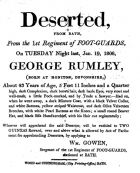
  • A Victorian deserter's family story: surviving a clash of loyalties

    Article

    More people than ever are seeking to trace their family histories. People can now sit at home and tap out in seconds from the  internet many of their family's previously unknown genealogical details. But what if a century or more ago one of your family had tried to cover his...

    Click to view
  • Buffalo Bill and his Wild West show opens London's Earl Court in 1887

    Article

    ‘It is often said on the other side of the water that none of the exhibitions which we send to England are purely and distinctively American', exhorted Mark Twain (Samuel Clemens) in an unsolicited letter of September 1884 to ‘Colonel' William Frederick Cody (1846-1917). ‘If you will take the Wild...

    Click to view
  • Landowners and their motives for change at the Suffolk village of Culford between 1793 and 1903

    Article

    Isabel Jones from Thomas Mills High School at Framlingham was the winner of the Young Historian Award for Local History [16-19] in 2006. The Director of the Young Historian Project, Trevor James, has edited her winning essay. It has been shortened and the footnotes removed, to enable it to fit...

    Click to view
  • Attitudes to Liberty and Enslavement: the career of James Irving, a Liverpool slave ship surgeon and captain

    Article

    Prior to abolition in 1807, Britain was the world’s leading slave trading nation. Of an estimated six million individuals forcibly transported from Africa in the transatlantic slave trade in the eighteenth century, almost 2.5 million (40 per cent) were carried in British vessels.2 The contemporary attitudes and assumptions which underpinned...

    Click to view
  • The Slave trade and British Abolition, 1787-1807

    Article

    In the 1780’s the British slave trade thrived. In that decade alone more than one thousand British and British colonial slave ships sailed for the slave coasts of Africa and transported more than 300,000 Africans. There was little evidence that here was a system uncertain about its economic future. If...

    Click to view
  • After the Uprising of 1956: Hungarian Students in Britain

    Article

    Much has been written during the last 50 years about the events leading up to and during the Hungarian Uprising of 1956. Less consideration has been given to the students who arrived in Britain as refugees. During the weeks following the Soviet intervention in Hungary around 25,000 people were killed...

    Click to view
  • Child Health & School meals: Nottingham 1906-1945

    Article

    Following Jamie Oliver’s devastating television series on the inadequacy of school meals the present government has been quick to be seen to address the situation. In September 2005, Ruth Kelly, the then Education Secretary, announced a war on junk food in schools.1 This was nothing new, because the history of...

    Click to view
  • The great Liberal landslide: the 1906 General Election in perspective

    Article

    On 1 May 1997 the Conservative party suffered an electoral defeat so overwhelming that political commentators were left rummaging through the statistics of the previous two centuries to find anything similar. The Times concluded on 3 May that it was the party's worst performance since 1832, though 'The disaster suffered...

    Click to view
  • Guy Fawkes in Manchester: The World of William Harrison Ainsworth

    Article

    Some of the most enduring myths in British history were created and perpetuated by novelists, despite the fact that the historical novel has long been relegated to the second division of the literary arts. Deeply unfashionable today, writers like Sir Walter Scott, Edward Bulwer Lytton and William Harrison Ainsworth were...

    Click to view
  • Twickenham as a Patriotic Town

    Article

    Twickenham from the 1890s onwards grew as a town with a special sense of history. Nobody in authority on the local council could quite forget the reputation which the district had acquired as a rural arcadia. The aristocrats and gentry who built villas in the parish in the late 17th...

    Click to view
  • Christopher Hill: Marxism and Methodism

    Article

    Christopher Hill, the eminent historian of seventeenth century England, was a convinced Marxist throughout most of his long and productive life (1912-2003). He embraced this secular world-view when he was a young History student at Oxford in the polemical 1930s and never lost his ideological commitment, even though he resigned...

    Click to view
  • How Nelson Became a Hero

    Article

    The fittest man in the world for the command' of the Mediterranean, Lord Minto declared of Horatio Nelson on 24 April 1798, following Nelson's inventive assault on Spanish ships off Cape St. Vincent. 'Admiral Nelson's victory [at the Nile]… is one of the most glorious and comprehensive victories ever achieved...

    Click to view
  • Thomas Muir and the 'Scottish Martyrs' of the 1790s

    Article

    From the 1750s, after more than a century of intense political and religious disputes and of economic stagnation, Scotland began to enjoy several decades of almost unprecedented political stability, religious harmony, economic growth and cultural achievements. Jacobitism had been crushed and most propertied and influential Scots rallied to the Hanoverian...

    Click to view
  • England Arise! The General Election of 1945

    Article

    ‘The past week will live in history for two things’, announced the Sunday Times of 29 July 1945, ‘first the return of a Labour majority to Parliament and the end of Churchill's great war Premiership.’ Most other newspapers concurred. The Daily Mirror, of 27 July, proclaimed that the 1945 general election...

    Click to view
  • The Friar's Bush

    Article

    Nothing on earth would have persuaded me to enter the place… it was the house of the dead. Paul Henry, artist (1876-1958) The Friar's Bush cemetery on the Stranmillis Road in Belfast may only be two acres in size, but its history is far bloodier and grislier than you would...

    Click to view
  • Lloyd George & Gladstone

    Article

    Lloyd George, who died sixty years ago on 26 March 1945, grew up and began his Parliamentary career in Queen Victoria's reign. In taking up a major Welsh issue, disestablishment of the Church of Wales, he memorably clashed with William Ewart Gladstone, perhaps the greatest of all Liberal Prime Ministers....

    Click to view