

Holocaust Memorial Day 2026
27 January 2026
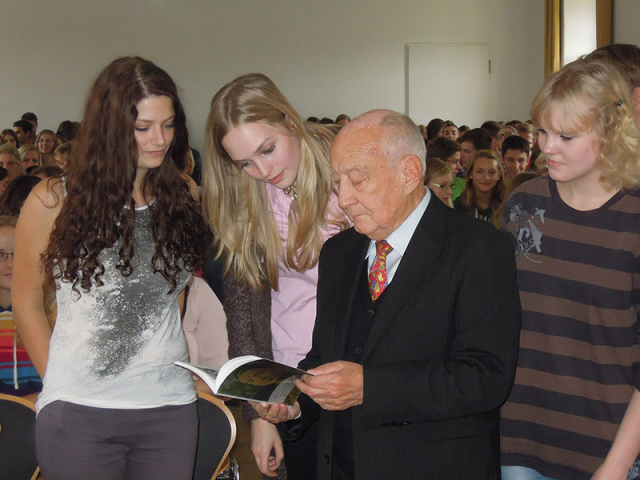
Bridging generations
It is over twenty years since Holocaust Memorial Day (HMD) was introduced in the UK. The purpose was to have one day where all the elements of the horror of the Holocaust (the Nazi Genocide against the Jews of Europe and the Gypsies, Roma and Sinti) and the Nazi Persecution and murder of other targeted groups (including political opponents, people of colour, gay groups, Jehovah's Witnesses, those with disabilities and more), could be learnt about and reflected upon.
The Holocaust as an historical subject is on the National Curriculum, but after consideration it was realised that learning about the historical components of the Nazi period, how people were killed and the social and political conditions that enabled industrial mass murder, was not the same as reflecting on the moral implications and legacy. What is more, it is not just children aged 13/14 years at school (who may not be mature enough, and certainly don’t have enough life experience to truly comprehend the magnitude of what happened) who need to be able to take on some of the wider and most tragic elements of the events of the Holocaust and the violence of that time. Therefore, a remembrance day for the Holocaust was introduced. Each year a different focus is adopted, in part to understand and explore the scale and breadth of impact of what happened over 80 yeas ago and why it still matters.
For 2026 the theme is ‘Bridging Generations’, a reminder that is the responsibility of all ages to tell the stories of the people who were murdered, those who fought back, those who resisted, those who stood by, and those who chose to be perpetrators. It emphasises that communication between generations, sharing knowledge and information have a role in understanding the past, regardless of age or curriculum, to foster empathy and inspire action to ensure that the horrors of the past can be learnt from.
Today HMD serves as a springboard for a wider discussion on other genocides and crimes against humanity. Thus it ensures that the Holocaust is not just an historical event or one for a meaningless outpouring of grief but one that signals why racism, antisemitism, prejudice of the other and persecution of those who are different, have disabilities or have different ways of expressing their sexuality, are wrong and can lead to devastating effects across societies and generations.
The victims of the Holocaust and Nazi persecution included all ages, from newborns to the very elderly. Generations of knowledge and experience were lost and potential generations of hope for the future destroyed. It is fitting that this year the extent of loss is recognised and that it is through the cooperation of different people, including those of different ages, that knowledge and understanding can be shared, to fully discuss why the moral implications of the Holocaust and Nazi persecution are as important as the historical series of events and actions.
Previous Holocaust Memorial Day webinars
- 2025 recorded webinar: Mapping uncertainty: Retracing the trajectories of young survivors in the immediate aftermath of the Holocaust
- 2023 recorded webinar: Ordinary People
- 2022 recorded webinar: Using 'One Day' to explore the actions that helped to lead to the Holocaust and actions of genocide
General resources
- Why does the massacre of the Armenians in the First World War still get overlooked?, Paula Kitching (Virtual Branch recording)
- Anti-semitism and the Holocaust, Sarah Newman (Historian article)
- Nazi aggression: planned or improvised?, Hendrik Karsten Hogrefe (Historian article)
Secondary resources
- Recorded webinar: Making the most out of Holocaust Memorial Day
- Teaching controversial histories: The Holocaust (podcast)
- Integrating the historical Holocaust, Sam Ineson (Teaching History article)
- Using the concept of place to help Year 9 students to visualise the complexities of the Holocaust, Stuart Farley (Teaching History article)
- How ‘good’ are Key Stage 3 textbooks in supporting the teaching of the Holocaust?, Alex Diamond (Teaching History article)
Primary resources
- Is there a place for the Holocaust in the Primary Curriculum?, Martin Winstone (Primary History article)
- ‘So why did they go into hiding?’ Anne Frank in her historical and social context, Darius Jackson (Primary History article)
- Teaching controversial history at primary school (podcast)
- Recorded webinar: Making the most out of Holocaust Memorial Day