

The National Year of Reading 2026
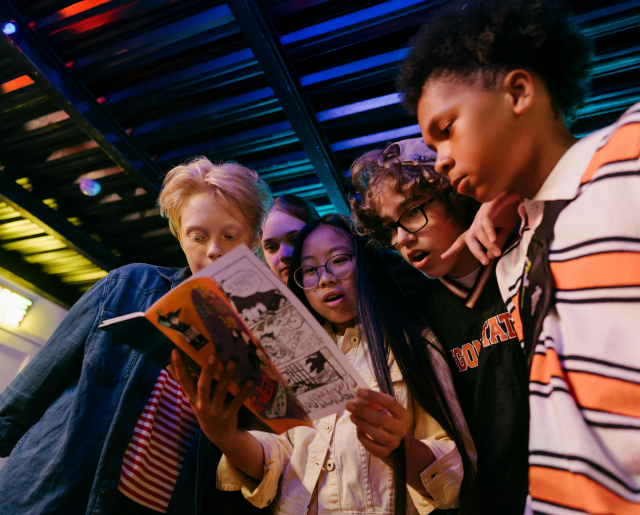
2026 is the National Year of Reading – and the Historical Association is celebrating it!
2026 has been declared as the National Year of Reading, a timely reminder of the importance of literacy, but also the power of the written word.
Throughout recorded history the ability to read and write has been an important form of communication, often used to control access to power and to increase engagement in society. The introduction of universal compulsory education at the end of the nineteenth century in the UK marked a turning point for society and attitudes to inclusion. In fact, the chronology of mankind can be pieced together through literary texts as much as physical and environmental evidence.
While the need to read and write is essential in the modern era, the practice of reading to develop knowledge, pursue research, study and read for enjoyment has not always been championed. In recent years we are told that reading is no longer a pastime for many people, and that it is under threat from different forms of digital stimulus.
For historians, reading is more than a pastime: it is fundamental to our discipline, as well as an imaginative way to communicate historical events. Language is one of the basic tools for studying and researching history. Good literacy is essential for sharing the outcomes of a historical enquiry, framing arguments and expressing ideas and conclusions about the past. Studying history in the UK requires an ability to understand and access a wide variety of written sources, and using those sources increases literacy while developing both specialist and personal vocabulary. Records and events of the past have often been shared amongst groups and passed down through generations using stories and storytelling; these stories both support the historical record and continue it.
In 2016, Anthony Beevor, in his acceptance of the Medlicott Medal, stated that historians in the UK are popular authors as well as academics, because history written in English is often presented using ‘strong prose, and storytelling, rather than just academic arguments and statistics’. This makes history a pleasure to read, not just a vehicle for knowledge. In schools, a key pedagogical approach to teaching complex history is to use layered storytelling to deliver both breadth and depth of knowledge. This has been exemplified by another Medlicott Medal awardee (2025), Dr Christine Counsell. She is a keen advocate for story telling in schools’ history, frequently writing and speaking on her approaches and methods of using storytelling to teach history.
For many people of all ages, historical fiction is a key component to accessing the past, examining its people and the dilemmas othey faced, as well as the long term affects of key events. Reading fiction to explore history enables readers to visit a wide range of time periods, nations and peoples. How many of us still remember our favourite book as a child and how it made us want to find out more about a person, a place or a time? How contemporary events are represented in fiction by writers can also provide historians with both an insight in to the past and an understanding of how it was perceived at the time. Fictionalised accounts of a period can therefore be useful historical sources reflecting a past understanding: for example what does Jane Austen’s work tell us about social ideas of women in the Regency Period, or Jonathan Swift's writing about social divisions in Ireland?
Over the years, the Historical Association has been a active partner in promoting, celebrating and championing reading, and in 2026 we will be sharing that work more regularly. For instance, fifteen years ago, we created and developed the Young Quills Competition for historical fiction, a competition for published authors that provides young people with an opportunity to review new historical fiction and recognises the best of that new fiction. We also run a competition encouraging young people to write their own historical fiction.
Throughout this year, we will be highlighting our activities with fiction and making connections between history and reading in lots of interesting ways, sharing existing work and introducing new activities and talks. To celebrate the National Year of Reading we will bring you a story each month that celebrates history, reading and the power of that connection.
To help us spread the word on the power of history and reading use our Social Media accounts: Instagram, BlueSky and LinkedIn to send us your favourite historical reads, tagging us (#historicalssociation #histassoc) and we will share with our audiences.
- See our June themes for the Year of Reading
- See our local history reading links