

Foreign Prisoners of War and Humanitarian Governance in Revolutionary Russia
When the Bolsheviks seized power in October 1917, they inherited responsibility for around two million foreign prisoners of war – mostly soldiers from the Germany and Austro-Hungarian armies – captured during the First World War. Dispersed across the former Russian Empire, from the Baltic to Siberia and Central Asia, these prisoners posed a major administrative and humanitarian challenge at a moment of institutional collapse, economic dislocation, and civil war.
The early Soviet state sought to address this problem through centralisation. In April 1918 it established the Central Collegium for Prisoners and Refugees (Tsentroplenbezh), responsible for coordinating the care, registration, labour, and repatriation of prisoners, as well as refugees and displaced persons (totalling nearly ten million people). The administration of POWs offers a revealing perspective on early Soviet governance. While the Bolshevik regime is often – and rightly – associated with violent rupture and coercion, its approach to POWs instead reveals a more complex combination of improvisation under crisis and continuity with pre-revolutionary humanitarian practices and international legal norms.
Crisis and collapse
Conditions for POWs deteriorated sharply after 1917. During the war, the Tsarist government had developed systems to manage camps, supply food, and organise labour. Their collapse had immediate consequences. Transport networks broke down, food supplies dwindled, and administrative oversight fragmented. In many regions, local authorities lacked the resources to provide adequate rations or medical care.
The consequent decline in living conditions in POW camps was documented by contemporary reports describing overcrowding, shortages of clothing, and widespread disease. Epidemics such as typhus spread rapidly among populations weakened by malnutrition and poor sanitation. In some cases, prisoners were dispersed into labour detachments in remote regions, where oversight was minimal and abuses more likely. Repatriation, which began unevenly after the Treaty of Brest-Litovsk, added further instability. Prisoners often moved across a collapsing transport system without clear direction, while local authorities frequently ignored central directives, undermining attempts at coordination.
These conditions reflected a broader humanitarian crisis affecting refugees and civilians. However, foreign POWs posed additional diplomatic concerns. German commissions, permitted to operate in Soviet Russia after Brest-Litovsk, reported poor conditions and pressed for improvements, and Soviet officials were aware that the treatment of foreign prisoners could affect Russian POWs held abroad.
In response, Tsentroplenbezh constructed a centralised framework for managing prisoner affairs. Initially led by senior Bolshevik Iosif Unshlikht, the institution was responsible for coordinating housing, care, labour, and evacuation. Its policies reveal a consistent concern with humanitarian standards, even as implementation remained constrained by the wider crisis. Tsentroplenbezh’s regulations emphasised food provision, medical care, and sanitation. Camps were instructed to establish disinfection facilities and medical commissions to combat disease. Soviet officials explicitly engaged with international law through formally recognising the Geneva Convention in May 1918, and officials also argued that the principles of the Hague Conventions governing POW treatment remained applicable. Tsentroplenbezh, Unshlikht suggested, was pursuing objectives of an ‘international character’ in ensuring the humane treatment of prisoners.
The evidence, then, suggests that Soviet administrators understood their responsibilities in broader humanitarian terms. Even where strict adherence was difficult, officials argued that efforts should be made to alleviate the suffering of POWs. Debates within Tsentroplenbezh extended to questions of principle, including which prisoners should be prioritised for repatriation according to humanitarian criteria. In 1920, Unshlikht’s successor at Tsentroplenbezh, Alekandr Eiduk, emphasised that the Soviet republic bore a ‘moral responsibility’ for the humane treatment of POWs.
Limits of implementation
In practice, however, the implementation of humane treatment was uneven. The Soviet state remained highly fragmented, and Tsentroplenbezh struggled to assert authority over competing institutions. Military units, local soviets, railway authorities, and security organs often acted independently. The Cheka (the secret police) frequently treated POWs as a security concern, while local authorities sometimes retained them as a source of labour. In regions such as Siberia, prisoners were often integrated into local economies, despite central directives to the contrary. Nevertheless, the persistence of these policies, and the efforts to enforce them, indicate that Soviet administrators recognised their obligations. Even where implementation proved inconsistent, there was a sustained attempt to construct a system capable of addressing the humanitarian needs of POWs under extremely adverse conditions.
The administration of prisoners of war also reveals important continuities across the revolutionary divide. Many of the techniques employed by Tsentroplenbezh had been developed during the First World War under the Tsarist government. In the early years of the civil war, the Soviet regime relied on neutral humanitarian organisations, particularly the Red Cross, as well as on pre-revolutionary civic bodies, to assist in the provision of aid.
Continuities are also evident at the level of legal and intellectual frameworks. References to the Hague and Geneva conventions appeared frequently in discussions of prisoner treatment. Late imperial legal scholars such as F.F. Martens and Mikhail Taube had developed sophisticated analyses of international humanitarian law before 1917. These debates did not disappear with the revolution. Instead, Soviet jurists such as Evgenii Korovin reworked existing concepts, adapting them to the ideological and political context of the new regime.
The management of foreign POWs in early Soviet Russia thus reveals a hybrid system of governance. It combined revolutionary ambition with inherited administrative practices, and humanitarian aspiration with the severe constraints imposed by civil war. While conditions often deteriorated dramatically, Soviet officials continued to articulate policies grounded in international humanitarian norms.
Rather than viewing this Soviet experience of POW management solely as a precursor to later systems of repression in the Stalinist GULAG, it is more productive to situate this within the broader context of post-First World War humanitarian administration. Across Europe, states faced similar challenges in managing large prisoner populations and navigating the aftermath of mass captivity. The Soviet case, shaped by revolution and civil war, reflects both the limits of state capacity and the persistence of humanitarian frameworks under extreme conditions.
This blog is based on a research trip funded by a History Research Bursary.
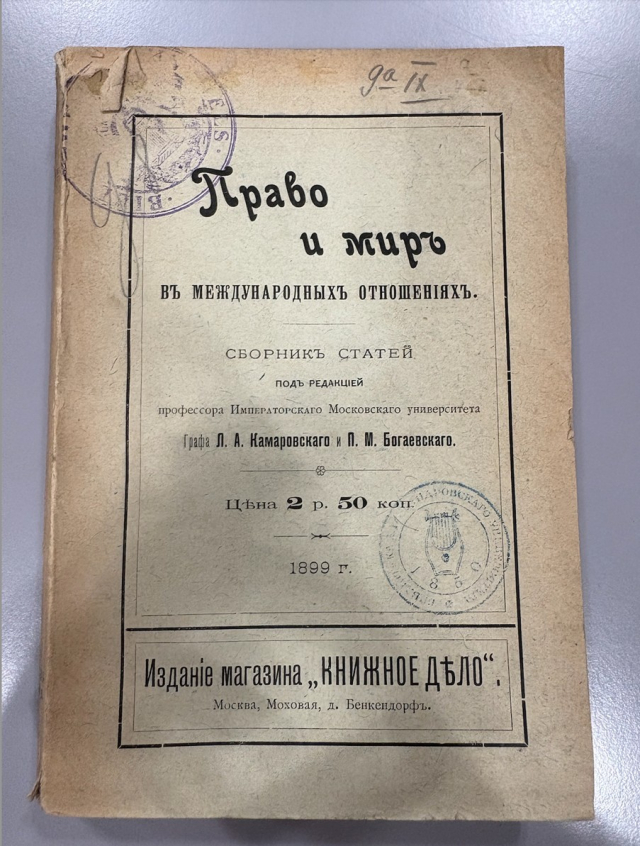
Image: Pravo i mir’ v’ mezhdunarodnykh’ otnosheniiakh’. Sbornik’ statei, eds. L.A. Kamarovskii and P.M. Bogaevskii (Moscow, 1899). Slavonic Library, National Library of Finland